


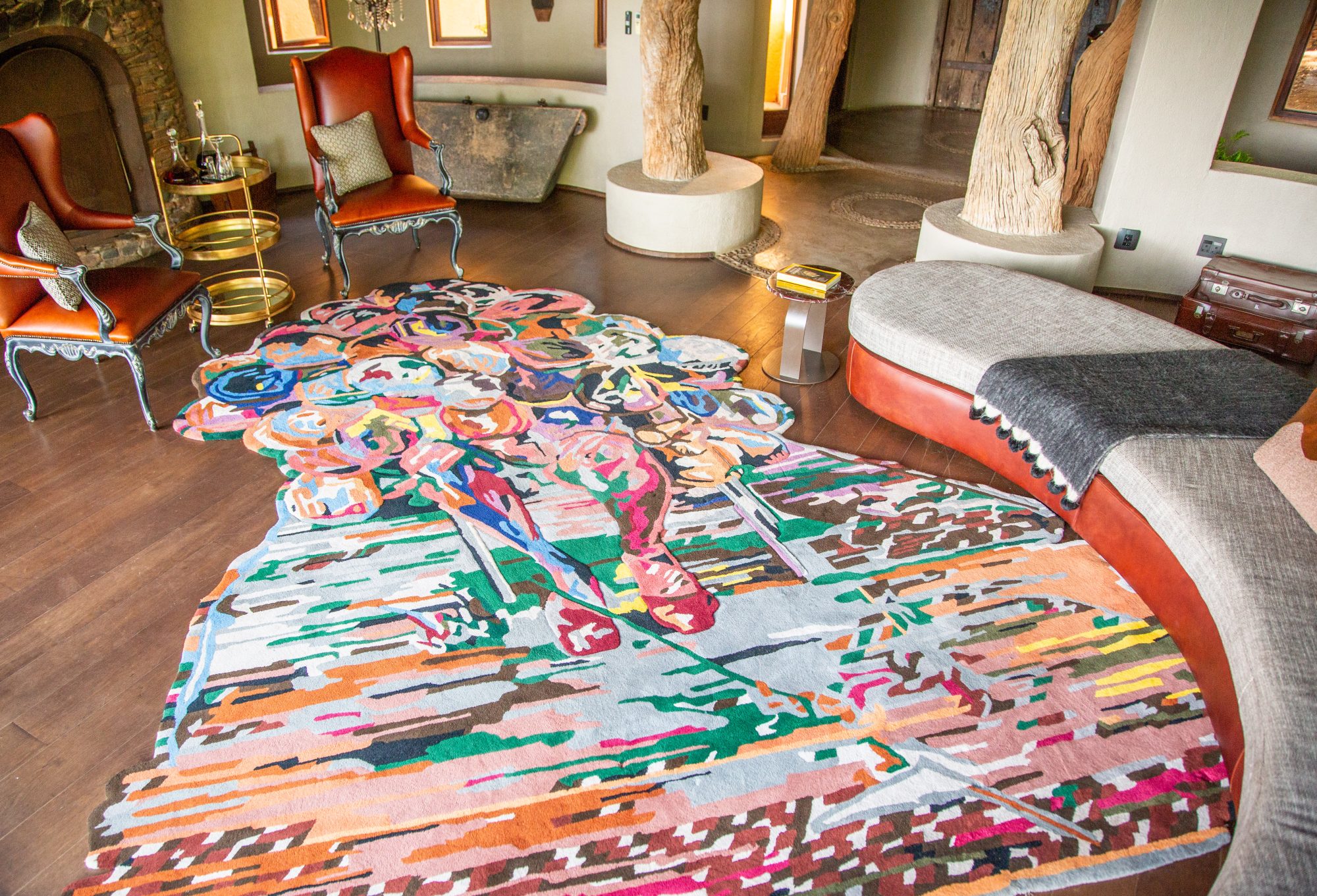
The Rug Collection at Molori Safari
At Molori Safari, what lies underfoot is part of the story. Our rugs are not neutral backdrops or soft fillers chosen to “finish” a room, they are works of contemporary African art, translated into woven form, and placed exactly where guests exist during their stay. Functional objects, yes, but each carries form, beauty, and story, elevating it far beyond the ordinary.
If Molori Safari is known for anything beyond its connection to Madikwe Game Reserve’s extraordinary wildlife, it is for its unapologetic commitment to design – plush, elegant, and unapologetically African. And our rug collection is perhaps the clearest expression of that philosophy.
Art You Don’t Tiptoe Around
The idea for our rug collection began not as a decorative exercise, but as a question back in 2020: What happens when contemporary art is allowed to live beyond the wall? As part of Molori Safari’s interior refresh led by Hesse Kleinloog, Andrea Kleinloog approached Koos Groenewald of Jana+Koos with a simple but ambitious brief: could art live on the floor? Koos’ first original rug became the catalyst for something far larger.
Those who have stayed with us will know that many of our lodge’s interior walls are unconventional, curvy; with few flat surfaces to display traditional art. The solution was radical yet simple: Why not place the artwork on the floor?
Working closely with Molori’s owners and design team, Jana+Koos collaborated with leading South African contemporary artists – Athi-Patra Ruga, Cameron Platter, Jody Paulsen, Maja Marx, Nabeeha Mohamed, among others – whose work could bring something unique to each space – from the suites to the shared areas. Different voices, different moods, different energies were carefully chosen so that each rug would feel fresh, yet still harmonise with the overall lodge.
From Canvas to Textile: Translating Art into Rugs
Jana+Koos translated the artists’ works into digitised patterns, which were then woven by local craftspeople, considering colour, scale, texture, and the translation from canvas to textile. The result is not a replica of the original artwork, but a transformation; tactile, functional pieces that carry the spirit of the original artwork, while gaining a new life underfoot.
Each rug is striking in its own right, but their effect is cumulative. They quietly define their space, subtly shaping mood, guiding the eye, and inviting guests to pause and engage with the artistry beneath their feet. Keep reading to see which rug graces each space.
Nabeeha Mohamed’s Rug
A bold, layered composition drawn from three of Nabeeha Mohamed’s original watercolours, this rug captures her signature portrayal of intimate, everyday moments in vivid colour. Translated from paper into woven form for the first time in her practice, the piece gains depth and texture, becoming a tactile artwork that feels both personal and playful underfoot.
Athi-Patra Ruga’s Rug
Rooted in Athi-Patra Ruga’s celebrated performance and tapestry work, this rug brings theatrical colour and layered symbolism into Molori’s interiors. The translation from live performance to textile creates a richly textured piece that stays true to the artist’s ethos of stretching across mediums to reach new audiences.
Jody Paulsen’s Rug
Adapted from Jody Paulsen’s iconic Eat Me (Bananas), this striking yellow-and-black rug electrifies Molori Safari’s main lodge. Originally conceived as a felt collage, the artwork takes on new life as a woven centrepiece, inviting guests into a moment of playful provocation and joy.
Maja Marx’s Rug
Inspired by flowing ribbons and the expressive power of line, this rug translates Maja Marx’s inky original artwork into a sculptural, embossed textile. The movement of line and depth of texture create a sense of rhythm beneath your feet, turning a painterly gesture into an immersive design experience.
Koos Groenewald’s Rug
Drawn from a mixed-media artwork found in Koos Groenewald’s studio, this rug brings texture, humour, and a hint of mischief into Molori’s interiors. Playful and slightly provocative, it reflects the spirit of experimentation that sparked the rug collection in the first place.
Cameron Platter’s Rug
Based on Cameron Platter’s A Night of Bliss, this rug depicts a deconstructed lion in full dance-floor abandon. Energetic, surreal, and joyfully irreverent, the piece transforms fine art into a large-scale woven statement that brings movement and personality into the space. It is entirely at ease amid Molori’s interiors.
Spaces That Understand Texture
Beyond their visual impact, our rugs speak to something central to Molori Safari’s identity: A belief that true luxury is layered, personal, and expressive. The Ichikowitz family’s larger art collection has been built over time, guided by curiosity rather than convention, and guests get to experience it in full effect during their stay. Choosing to turn artworks into rugs, to place them underfoot rather than on the wall, reflects that same willingness to challenge expectations.
The rug project sits naturally within Molori Safari’s broader interior vision, which was shaped by South African design studio Hesse Kleinloog.
Here, rugs are not an afterthought; they anchor rooms, soften expansive interiors, and add depth to spaces framed by glass and sweeping views. Against the raw vastness of Madikwe’s landscape, the interiors feel grounded and tactile, rather than ornamental.
Stay With Us
There really is no way to describe the scale and beauty of our rugs and like most art, it needs to be experienced to be understood.
If you’re drawn to design, and looking for your next luxury safari, our lodge isn’t one you can pass up. Combining the ultimate in experience and comfort, Molori Safari is certainly one for the books!
We invite you to browse our gorgeous suites and get in touch with our team at reservations@molorisafari.com to secure your dates.
Alternatively, feel free to book your own stay by making use of our online booking platform.
Join us and experience the artistic side of a safari in Africa in a way few ever do!